


Ageism is Visible. Accountability is Not.
Look around. Ageism exists in every society. With the young and the old. I see it in policy. In practice. In everyday life. In the way older people are spoken about, and spoken over. It sits inside systems where decisions are made about the box you belong in, and who gets to stay out of it.
My focus here is on what that means for people in later life.
What I have noticed over many years of being in the business of ageing is how quickly we reach for a campaign or an awareness day as if a hashtag might do the work that only real change requires. I have done it too.
Naming something is not the same as changing it
I am not against campaigns. Awareness matters. But we have started to behave as if visibility alone will do the work, as if once enough people nod along, policy will quietly fall into line. It does not.
We often hear that ageism is the last acceptable “ism.” Casual ageist jokes are still mainstream. Older people are still framed as problems to be managed, costs to be contained, rather than citizens with rights and lives still unfolding. But we should be honest. We have not exactly cracked racism, sexism, homophobia or ableism either. Decades of awareness campaigns have not closed the gaps in safety, pay, health, representation or power. Naming the problem is necessary. It is not a plan.
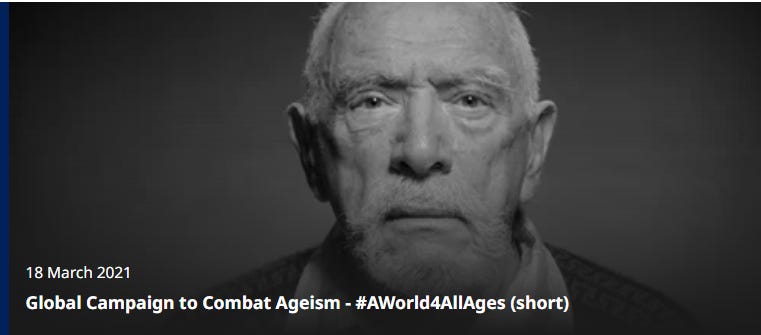
It is nearly five years since the WHO released its Global Report on Ageism, with clear evidence and a road map for action. Since then there have been new slogans, social media days, strategy documents. There have been very few hard changes in law, funding or accountability that older people can point to in their own lives.
At times awareness has been allowed to stand in for action for too long.
So what would combatting ageism actually look like?
It would mean enforceable protections against age discrimination in healthcare not soft guidance. When older people are denied treatments, written off as “too old to benefit,” or never offered certain options in the first place, there would be somewhere real to go with that. Not just a story we tell each other afterwards.
It would mean employment law and mentorship programs do not quietly filter out older candidates, and there are real consequences for employers who side line people in their 50s, 60s and beyond.
It would mean treating older care workers as skilled, essential labour, not something to be squeezed for efficiency. Better pay, training and conditions for the people who hold older people’s lives in their hands.
And it would mean older people in the room where decisions are made. Not brought in at the end as “consulted stakeholders,” but shaping decisions from the start on hospital boards, research ethics committees, in city planning and national policy.
What has actually changed where you live?
This is the question that is worth sitting with.
The WHO report was launched with evidence, tools and a call to urgent action. What has changed where you live? A new law. A funded programme. A shift in how services are actually delivered. A decision that older people can feel in their own lives.
If the honest answer is “not much,” then awareness is doing far less work than we say it is.
From slogans to consequences
Awareness campaigns have a place. But when they are not tied to specific structural demands, it slips easily into performance.
We say the right words. We post the right graphics. And underneath, very little moves.
The harder work is to name the concrete barriers that stop older people from living the lives they want and to back specific actions that actually remove them. That work will not come from WHO in Geneva. It will come from parliaments, ministries, health services, councils, unions, professional bodies, community groups. From people who read reports and then turn up to do the slow, local work of changing how care is funded, how services are designed, who sits at the table.
Awareness can open the door. Walking through it and changing what is on the other side is slower, harder and more uncomfortable.
Which brings me to the question underneath all of this, the one I am asking myself as much as anyone else:
What is my role in that? And what is yours?
Jane, you so aptly describe the problem. When I first recognized that my loss of self-confidence was due to self-directed ageism in my late 60s, I decided to devote the next years to educating others about it. As you wrote, awareness is the first step but isn't enough. I've had a TEDx talk, Embrace Age with a Longevity Mindset, viewed by 140 K people and the book that I've been working on for close to 5 years will come out in the next few days. It's called ReSet: Making the Most of the Rest of Your Life. The first half of the book provides the context---why ageism thrives, and the second part is what you can do about it. I'm hoping it reaches a wide audience, but I realize that what needs to happen is action today. I'm working on it. Thanks for your many thought-provoking articles.
We are so on the same wavelength. We need a movement. It starts but doesn't end with consciousness raising. But we won't see policy change if the consciousness isn't there.